
Some Events at Caputo’s Are Great. Some Are Rare. March 24th Was Both.
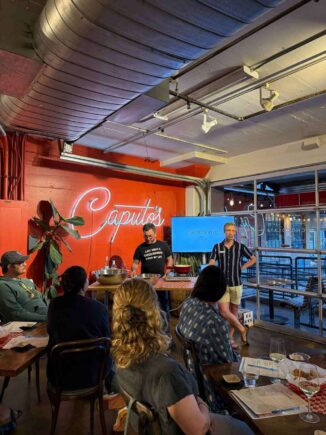
“If Parmigiano is the King of cheese,” Adam Moskowitz said, “1655 is the Queen.” He said it while managing five or six simultaneous batches of fondue, serving 60 people hot from the pot, and running what had by that point become equal parts cooking class, party, and comedy show. It was a weeknight in Salt Lake City, and it was one of the better evenings we have had in this building.
Here is how it came together.
Who Is Adam Moskowitz
 Adam founded the Cheesemonger Invitational in 2010, a competition that has become the defining event in American cheesemongering. Candidates are tested on technical knowledge, cutting precision, salesmanship, and palate. Through Columbia Cheese and Larkin Warehouse, he has spent decades connecting American retailers with some of the finest producers in the world.
He is also a close friend of Matt Caputo, which is a significant part of why this visit was what it was.
The documentary about his work, The Big Cheese, is currently making its way through the independent film festival circuit. It follows Adam’s coaching of the USA cheesemonger team through their campaign at the Mondial du Fromage, the world championship of cheesemongering, where they came home with 1st and 3rd place best cheesemonger in the world. If you want to understand what serious cheesemongering looks like from the inside, watch for it.
Five Days in Utah
Adam and Max arrived with a full agenda. Fishing. Skiing on one of Utah’s classic bluebird spring days, the kind where the sun is so strong and the sky so blue that you forget entirely about sunscreen until it is too late.
 Climbing sessions at the gym, because Max competes and takes it seriously. Dinners at the Caputo home and around Salt Lake City.
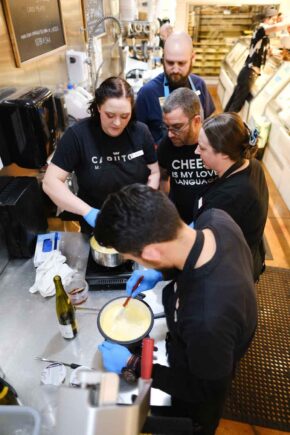
Somewhere in all of that, Adam also trained the Caputo’s crew across multiple locations.
This is worth pausing on. A staff training with Adam Moskowitz is not a courtesy visit. It is a direct transfer of knowledge from someone who has spent decades building the most rigorous cheesemonger education program in the country. He brought bites of cheese, deep industry knowledge, nerdy tasting spreadsheets, and an enthusiasm for the curd that must be experienced to be understood.
Each training was scheduled for an hour. The rabbit holes went deeper. The afternoon was a whirlwind of tasting, history, and at least a couple of missed deadlines. Adam kept half an eye on the clock, carved out a window to change out of his ski clothes, and made his way downtown for the class that evening.
The Class. Or The Party. Or The Comedy Show.
The evening opened with Adam’s signature call-and-response chant. Moo. Baa. Maa. Sixty people repeating it back, the energy immediately somewhere between a cooking class and a revival meeting. There were regular Caputo’s customers in the room and a solid contingent of Ca
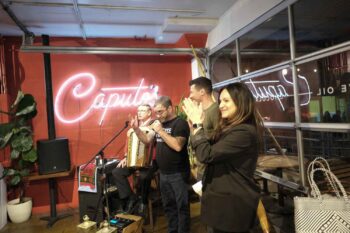
puto’s own cheesemongers who were not about to pass up an evening learning from one of the greats. Within two minutes, Adam had the entire room completely in his hands.
What followed over the next few hours was genuinely hard to categorize. Real instruction. A lot of laughing. By the end of the evening the most accurate description was probably: one third class, one third party, one third stand-up set by someone who happens to know more about Swiss cheese than almost anyone alive.
The Recipe: Moitié-Moitié
The recipe was a classic Moitié-Moitié — half and half, the traditional Swiss fondue formula that splits the pot between two cheeses of very different character. Adam’s version used Vacherin Fribourgeois Alpage and 1655 Gruyère from Fromagerie Le Crêt.
Vacherin was selected for its higher moisture and better meltability. Gruyère was selected for its bolder flavor to balance the pot. The challenge with any fondue is nailing the emulsion without losing the consistency. Acidity from white wine prevents the proteins from clumping and builds viscosity. Cornstarch binds and stabilizes. Add consistent stirring, and the pot comes together.
The Cheeses
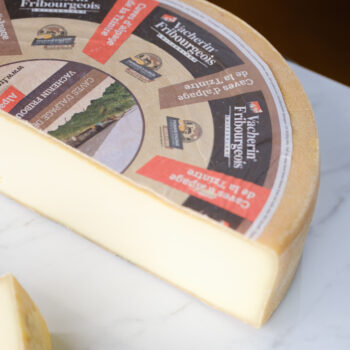 Vacherin Fribourgeois is the quieter of the two, which is not the same as simple. Made in the canton of Fribourg in western Switzerland, it is an AOP-protected washed-rind wheel with a dense, supple paste and a flavor that starts mild and creamy and gets progressively funkier with age. Someone at the class described notes of rubber band, and they were not wrong. That edge is part of what makes it interesting in the pot rather than just creamy. The Alpage designation means the milk came from cows at high-altitude summer pasture, when the grazing is at its most complex and that complexity carries through to the cheese.
1655 Gruyère from Fromagerie Le Crêt is the backbone. Firm, crystalline at full age, with deep caramelized and nutty character built over 12 months or more in the cave. The name references the year the Gruyère tradition was first documented. It is not a marketing claim. It is a statement about continuity and about what a cheese can be when a tradition is taken seriously across centuries. When Adam said that if Parmigiano is the King of cheese, 1655 is the Queen, he was not reaching for a metaphor. He was describing what is in the wheel.
In the fondue pot, Vacherin provides the melt, the creaminess, and just enough funk to keep things alive. Gruyère provides the structure, the depth, and the backbone. The Moitié-Moitié formula exists because neither cheese alone does what both cheeses do together.
The Pull
Adam made five or six full batches over the course of the evening. Each time one was ready, attendees lined up and he served it himself, hot, directly over roasted vegetables and bread. The cheese pulls were the kind that stop conversation mid-sentence. The kind that make you briefly forget there are 59 other people in the room waiting their turn.
Consider what that looks like from a production standpoint: one person, managing that volume of output, keeping every pot right, serving 60 people, and never losing the thread of the instruction and conversation happening around him the entire time. It was a masterclass in competence disguised as a party.
The Drinks
The fondue called for something alpine, and Caputo’s own Crystal Daniels delivered on both ends of the evening.
To open, Crystal built a cocktail around Génépy, the herbal alpine liqueur that shares its DNA with the mountain pastures that produced the cheese. She combined it with gin to push the more herbaceous botanicals, added a homemade mulberry cocoa tea syrup to coax out the floral notes, then rounded it with lemon and dry vermouth. Light, layered, and exactly right for what followed.
The wines were chosen to match the terrain. Gustave Lorentz Pinot Blanc from Bergheim in Alsace opened the evening and paired cleanly with the cheese before it hit the pot. For the fondue itself, guests drank Schenk L’Alpage Chasselas from Mont-sur-Rolle, Switzerland — the same wine Adam used to bind the emulsion.
What This Week Left Behind
When someone with Adam’s credentials takes time to teach your crew, the knowledge does not stay in the room. It shows up in every conversation with every customer who walks in and asks what they should try. The Caputo’s crew knows more today than they did the week before he arrived, and that is the whole point of building relationships like this one.
If March 24th was not on your calendar, make sure the next one is. Classes & Events →
Event Highlights & Details
What was the recipe featured at the class?
A traditional Swiss Moitié-Moitié fondue made with Vacherin Fribourgeois Alpage AOP and 1655 Gruyère AOP from Fromagerie Le Crêt, emulsified with white wine and cornstarch.
Who hosted the event?
Adam Moskowitz, founder of the Cheesemonger Invitational, owner of Columbia Cheese and Larkin Warehouse, alongside the Caputo’s team in Salt Lake City.
Where can I attend future Caputo’s classes?
You can view upcoming tasting experiences, maker visits, and educational workshops on our Classes & Events page.